
-
Our Services
- AI with HKPC PICASSO
- The Cradle – Go Global Service Centre
- New Industrialisation
-
Smart Manufacturing
- Smart Manufacturing
- IIOT
-
AI & Robotics
- AI & Robotics
- Unmanned Logistics Center Technology
- Applying Embodied Intelligence to Industrial Operations
- AI Sheet Metal Surface Defect Detection Technology
- Product Innovation and Design Management
- Smart Manufacturing/ New Industrialisation Assessment and Implementation
- Application and Research on Vision and Ultrasonic Inspection Assisted by Artificial Intelligence and Robotics
- Development and Implementation of Intelligent Production Lines
- Autonomous Air-ground Cooperative Tunnel Inspector
- AR-Empowered Robot Control System (ARERC System)
- IoT-enabled Smart Toilet Bowl Cleaning System
- Novel Materials
-
Advanced Manufacturing Technology
- Advanced Manufacturing Technology
- 3D Scanning and Reverse Engineering Service
- Flexible Metallic Fiber Physical Porous Part Fabrication Technology
- Dual Laser Metal Polishing Technology
- Advanced Additive Manufacturing, 3D Printing Technology, and Direct Manufacturing
- Electrically-Assisted Free Forming (EAFF) Technology for Customisation of Sheet Metal Parts
- Plastic Process and Machinery Technology
- Fashion and Garment Technology
- Watch Assembly Automation Technology
-
HealthTech and Traditional Chinese Medicine
- HealthTech and Traditional Chinese Medicine
- R&D service and Functional Investigation on Chinese Medicine, Health Food & Wellness product
- Compliance Consultation Service for Chinese Medicine, Pharmaceutical, Health Food and Medical Device Industries
- Manufacturing Enhancement - Automatic Intelligent System for Production and Packaging in Chinese Medicine, Pharmaceutical and Health Food Industries
- Assisting funding application for local medicine and health industrial associations
- “The Cradle” Services for Health Tech and TCM Industry
-
Digital Transformation
- Digital Transformation
- HKPC Digital DIY Portal
- Digital Transformation Support
- Intelligent Integrated Non-wearable and Wearable Health Monitoring System and App for Elderly Homes
- Smart Solution
- Research and Analytics
- Embedded Software System
- DevOps Maturity Assessment and Consultancy Service
- Software Testing Automation Consultancy Service
- Blockchain Consulting Service
- Extended Reality (XR) technology and consultancy service
-
Cyber Security
- Cyber Security
- Cyber Security
- Cybers Security-by-design, Privacy and Compliance-by-default
- Design & Architecture
- Train & Develop
- Offensive Security
- Intelligent Security
- Defensive Security
- Intelligent Hardening
- Internet of Things (IoT) & Operational Technology (OT) Cyber Security Testing
- Phishing Defence Services
- Cyber Security Assessment & Audit
- Cyber Security Consultancy for i4.0 & e4.0
-
Green & Smart Living
- Green & Smart Living
- Green Technology
- Food Technology
- Smart Living
-
Corporate Sustainability
- Corporate Sustainability
- ESG and Sustainability Services
- Manufacturing Technology (Tooling, Metals & Plastics) Recognition of Prior Learning (RPL) Mechanism
- Market Research and Analytics
- Business Innovation
- Sustainability-related Standards and Guidance
- Organisation Innovation Capability Development
- District Innovation
- Customer Service Assessment
- Intellectual Property (IP) Protection and Management
- Support to Creative Industries
- Manufacturing Standards Consultancy Service
- Production Capacity Optimisation
- Cost of Quality
- HKPC Academy
- SME Support
- Funding
- Testing & Standards
- Venues & Facilities
-
Support & Resource
- Technology Transfer
-
Support Centres
- Support Centres
- Embodied AI International Applications Hub
- Hong Kong Industrial Technology Centre for Marine Economy
- Deep Tech Innovation Hub
- Circularity Research Centre
- Future Life and Health Tech Centre & Future FoodTech Lab
- Hong Kong Industrial Artificial Intelligence Robotics Centre (FLAIR)
- Intellectual Property Services Centre
- The Cradle – Go Global Service Centre
- Agentic AI and Industrial Metaverse Hall
- HKPC-HP 3D Printing Technology Centre
- Future Manufacturing Hall
- Hong Kong Technology and Innovation Support Centre
- Inno Space
- The HATCH
- Advanced Electronics Processing Technology Centre
- Green Living Laboratory
- Reliability Testing Centre
- Electromagnetic Compatibility Centre
- Plastics Technology Centre
- Smart Wearables, Watch & Clock Technology Centre
- Hong Kong Digital Testing Hub
- Hong Kong Industrial Drone Technology Centre
- Aqua Research Laboratory
- Advanced Materials and Intelligent Manufacturing Centre
- Hong Kong Joint Research Lab for Applications of Intelligent Automation Technology
- Testing & Standards
- HKPC Spotlights
- About US
-
 LANGUAGE
HKPC and Greater Bay Area Low-Altitude Economy Alliance Lead 50+ Organisations to Sign the “Joint Statement of Intent on Low-Altitude Aviation Standards and Interoperability” Supporting National and HKSAR Government Development Strategies Advancing Hong Kong as an International Hub for Low-Altitude Economy Standards and Collaboration
(Hong Kong, 21 September 2026) The Hong Kong Productivity Council (HKPC) and the Greater Bay Area Low-Altitude Economy Alliance (GBA LAEA), jointly initiated the “Joint Statement of Intent on Low-Altitude Aviation Standards and Interoperability” (the Statement of Intent). At the “Future of Low-Altitude Economy: An Inter-City Dialogue” forum recently held in September, representatives from over 50 industry, academia and professional organisations, signed the Statement of Intent to establish a collaborative framework for low-altitude aviation standards and interoperability, foster cross-border collaboration and promote the high-quality development of the industry. This initiative is highly aligned with the national 15th Five-Year Plan, the first Five-Year Plan for Hong Kong and the 2026 Policy Address, for the low-altitude economy and strategic emerging industries. It also leverages Hong Kong’s unique advantage of backed by the motherland and connected to the world, with a view to establishing Hong Kong as an international hub for low-altitude economy standards and collaboration.
As a technical partner of the HKSAR Government’s low-altitude economy “Regulatory Sandbox”, HKPC has been actively supporting the Government and industry in technology validation, standards development, talent training and application implementation. Building on its past practical experience in cross-border applications, multi-applications/users shared platform and Regulatory Sandbox projects, HKPC took the lead in initiating this Statement of Intent, inviting multiple industry and professional organisations to become supporting organisations, laying a solid foundation for the long-term development of the low-altitude economy.
Mr Mohamed BUTT, Executive Director of HKPC said: “HKPC fully supports the HKSAR Government’s Five-Year Plan and Policy Address measures for developing the low-altitude economy, which chart the direction for Hong Kong to advance strategic emerging industries and foster new productive forces. As the low-altitude economy develops rapidly, the coordination of standards and interoperability will be fundamental to scaling up the industry. HKPC is honoured to be an initiator of the Statement of Intent, joining forces with industry, academia and research partners in advancing low-altitude aviation standards research, technical collaboration and exchanges. Together, we aim to promote innovation, safety and coordinated development, while assisting Hong Kong to leverage its unique advantage of backed by the motherland and connected to the world, to build itself into an international hub for low-altitude economy standards and cooperation.”
Aligning with National and HKSAR Development Priorities to Drive High-Quality Growth of the Low-Altitude Economy
The national 15th Five-Year Plan, the first Five-Year Plan of Hong Kong and the 2026 Policy Address identify the low-altitude economy as an important direction for advancing innovation and technology, cultivating new productive forces and promoting industrial upgrading. The Five-Year Plan proposes to build the Asia-Pacific hub for low-altitude innovative applications, and advancing cross-border low-altitude logistics and coordinated industrial development in the Guangdong-Hong Kong-Macao Greater Bay Area; the Policy Address proposes to formulate and implement the “Action Plan on Developing Low-Altitude Economy”, focusing on promoting cross-border low-altitude logistics trial flights, the construction of an intelligent low-altitude traffic management system, and legislative work for non-conventional aircraft weighing over 150 kg, providing important institutional support for the industrialisation, scaling-up and cross-border development of the low-altitude economy. These measures signify that Hong Kong is gradually moving from low-altitude economy application validation to the stage of scaled development, and standards coordination, technical interoperability and cross-border collaboration, serving as key foundations for the industry’s long-term growth.
In support of the development strategies of the nation and the HKSAR Government, HKPC and GBA LAEA, jointly initiated the “Statement of Intent on Low-Altitude Aviation Standards and Interoperability”, to establish a collaborative framework for low-altitude aviation standards, fostering collaborative innovation among industry, academia and research sectors, and accelerating the implementation of low-altitude economy technologies and industrial development.
Uniting Industry, Academia and Research Sectors to Advance Standards and Interoperability in Low-Altitude Aviation
Under the Statement of Intent, all parties will focus on promoting coordination and cooperation in four key areas, including research on airworthiness and safety certification standards for aircraft; air traffic management (UTM); infrastructure and cybersecurity standards coordination; the construction of a cross-border low-altitude logistics and data interoperability framework in the Greater Bay Area; and the promotion of international standards for the low-altitude economy and global cooperation and exchange. All parties will refer to the airworthiness and safety certification frameworks of the Hong Kong Civil Aviation Department, the Civil Aviation Administration of China and other international aviation regulatory bodies, and jointly study the safety, compliance and technical benchmarks for unmanned aircraft, electric vertical take-off and landing aircraft (eVTOL) and other new types of aircraft, promoting low-altitude aviation standards coordination and cross-regional interoperability, and further enhancing the international competitiveness of the Greater Bay Area’s low-altitude economy development.
Advancing Alignment with International Standards and Building a Global Collaboration Platform for the Low-Altitude Economy
The Statement of Intent also sets out long-term goals, including promoting the establishment of a permanent international low-altitude aviation standards and interoperability cooperation platform, and promoting exchanges and cooperation with international organisations such as the International Civil Aviation Organization (ICAO), the International Organization for Standardization (ISO) and the IEEE Standards Association (IEEE-SA), so as to foster broader international consensus and cooperation mechanisms.
Looking ahead, HKPC will continue to serve as an important bridging role connecting government, industry, academia, research and investment sectors. Guided by its development direction of “rooted in Hong Kong, leveraging with GBA, serving the nation and bridging the world”, HKPC will work with the Government, industry and academia to continuously advance low-altitude aviation standards development, interoperability collaboration and innovative application validation. It will also accelerate the commercialisation of R&D outcomes and the implementation of cross-border scenarios, cultivate new quality productive forces in the low-altitude economy, and support Hong Kong in developing into an international innovation and technology centre and an important hub for the global low-altitude economy.
- Ends -
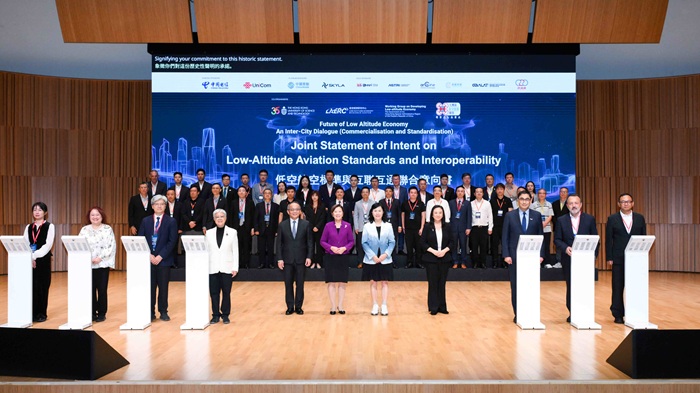 Witnessed by Ms Mable CHAN, JP, Secretary for Transport and Logistics of the HKSAR Government (centre, front row), Ms Elizabeth QUAT, SBS, JP, Legislative Council Member (fourth from right, front row), Mr Mohamed BUTT, MH, Executive Director of HKPC (third from right, front row), Professor Nancy IP, President of HKUST (sixth from left, front row) and Professor Tim CHENG, Vice-President of HKUST (fifth from left, front row), and Dr Winnie TANG, MH, JP, Vice President of the Greater Bay Area Low-Altitude Economy Alliance (fourth from left, front row), representatives of over 50 organisations from industry, academia and professional organisations signed the “Joint Statement of Intent on Low-Altitude Aviation Standards and Interoperability”, jointly initiated by HKPC and the Greater Bay Area Low-Altitude Economy Alliance.
FOLLOW US
SUBSCRIBE TO OUR NEWSLETTERS
Share the latest information of HKPC to your inbox