
-
Our Services
- AI with HKPC PICASSO
- The Cradle – Go Global Service Centre
- New Industrialisation
-
Smart Manufacturing
- Smart Manufacturing
- IIOT
-
AI & Robotics
- AI & Robotics
- Unmanned Logistics Center Technology
- Applying Embodied Intelligence to Industrial Operations
- AI Sheet Metal Surface Defect Detection Technology
- Product Innovation and Design Management
- Smart Manufacturing/ New Industrialisation Assessment and Implementation
- Application and Research on Vision and Ultrasonic Inspection Assisted by Artificial Intelligence and Robotics
- Development and Implementation of Intelligent Production Lines
- Autonomous Air-ground Cooperative Tunnel Inspector
- AR-Empowered Robot Control System (ARERC System)
- IoT-enabled Smart Toilet Bowl Cleaning System
- Novel Materials
-
Advanced Manufacturing Technology
- Advanced Manufacturing Technology
- 3D Scanning and Reverse Engineering Service
- Flexible Metallic Fiber Physical Porous Part Fabrication Technology
- Dual Laser Metal Polishing Technology
- Advanced Additive Manufacturing, 3D Printing Technology, and Direct Manufacturing
- Electrically-Assisted Free Forming (EAFF) Technology for Customisation of Sheet Metal Parts
- Plastic Process and Machinery Technology
- Fashion and Garment Technology
- Watch Assembly Automation Technology
-
HealthTech and Traditional Chinese Medicine
- HealthTech and Traditional Chinese Medicine
- R&D service and Functional Investigation on Chinese Medicine, Health Food & Wellness product
- Compliance Consultation Service for Chinese Medicine, Pharmaceutical, Health Food and Medical Device Industries
- Manufacturing Enhancement - Automatic Intelligent System for Production and Packaging in Chinese Medicine, Pharmaceutical and Health Food Industries
- Assisting funding application for local medicine and health industrial associations
- “The Cradle” Services for Health Tech and TCM Industry
-
Digital Transformation
- Digital Transformation
- HKPC Digital DIY Portal
- Digital Transformation Support
- Intelligent Integrated Non-wearable and Wearable Health Monitoring System and App for Elderly Homes
- Smart Solution
- Research and Analytics
- Embedded Software System
- DevOps Maturity Assessment and Consultancy Service
- Software Testing Automation Consultancy Service
- Blockchain Consulting Service
- Extended Reality (XR) technology and consultancy service
-
Cyber Security
- Cyber Security
- Cyber Security
- Cybers Security-by-design, Privacy and Compliance-by-default
- Design & Architecture
- Train & Develop
- Offensive Security
- Intelligent Security
- Defensive Security
- Intelligent Hardening
- Internet of Things (IoT) & Operational Technology (OT) Cyber Security Testing
- Phishing Defence Services
- Cyber Security Assessment & Audit
- Cyber Security Consultancy for i4.0 & e4.0
-
Green & Smart Living
- Green & Smart Living
- Green Technology
- Food Technology
- Smart Living
-
Corporate Sustainability
- Corporate Sustainability
- ESG and Sustainability Services
- Manufacturing Technology (Tooling, Metals & Plastics) Recognition of Prior Learning (RPL) Mechanism
- Market Research and Analytics
- Business Innovation
- Sustainability-related Standards and Guidance
- Organisation Innovation Capability Development
- District Innovation
- Customer Service Assessment
- Intellectual Property (IP) Protection and Management
- Support to Creative Industries
- Manufacturing Standards Consultancy Service
- Production Capacity Optimisation
- Cost of Quality
- HKPC Academy
- SME Support
- Funding
- Testing & Standards
- Venues & Facilities
-
Support & Resource
- Technology Transfer
-
Support Centres
- Support Centres
- Embodied AI International Applications Hub
- Hong Kong Industrial Technology Centre for Marine Economy
- Deep Tech Innovation Hub
- Circularity Research Centre
- Future Life and Health Tech Centre & Future FoodTech Lab
- Hong Kong Industrial Artificial Intelligence Robotics Centre (FLAIR)
- Intellectual Property Services Centre
- The Cradle – Go Global Service Centre
- Agentic AI and Industrial Metaverse Hall
- HKPC-HP 3D Printing Technology Centre
- Future Manufacturing Hall
- Hong Kong Technology and Innovation Support Centre
- Inno Space
- The HATCH
- Advanced Electronics Processing Technology Centre
- Green Living Laboratory
- Reliability Testing Centre
- Electromagnetic Compatibility Centre
- Plastics Technology Centre
- Smart Wearables, Watch & Clock Technology Centre
- Hong Kong Digital Testing Hub
- Hong Kong Industrial Drone Technology Centre
- Aqua Research Laboratory
- Advanced Materials and Intelligent Manufacturing Centre
- Hong Kong Joint Research Lab for Applications of Intelligent Automation Technology
- Testing & Standards
- HKPC Spotlights
- About US
-
 LANGUAGE
HKPC and the HKSAR Government's Working Group on Developing the Low-altitude Economy Jointly Organise Low-altitude Economy Regulatory Sandbox X “AI City Governance • LAE Unmanned Aircraft Operation Management Demonstration Centre” Showcase Advancing Hong Kong’s Low-altitude Economy Towards Development at Scale
(Hong Kong, 17 November 2026) The "Low-Altitude Economy Regulatory Sandbox – Showcase of the "AI City Governance · HKPC Unified Airspace Operation Management Demonstration Centre", jointly organised by the Hong Kong Productivity Council (HKPC) and the HKSAR Government's Working Group on Developing Low-Altitude Economy, and supported by the Digital Policy Office of the HKSAR Government, was successfully held today. The event gathered representatives from government departments, industry, research institutions, and technology partners to witness the official opening of the "Unmanned Aircraft Operation Management (UOM) Demonstration Centre" (UOM Centre) and to showcase the interim results of the "Multiple applications/Users Shared Platform" under the "Low-altitude Economy Regulatory Sandbox X". It also explored models for sharing low-altitude flight resources, fostering cross-departmental collaboration and enabling applications at scale, further accelerating Hong Kong’s low-altitude economy from pilot validation towards practical application and development at scale.
This year marks the opening year of the National 15th Five-Year Plan. As a strategic emerging industry, the low-altitude economy is a crucial direction for cultivating new productive forces. The Hong Kong SAR's First Five-Year Plan proposes to build Hong Kong into a hub for low-altitude innovative applications and to promote the coordinated development of cross-border low-altitude logistics and industries in the Guangdong-Hong Kong-Macao Greater Bay Area (GBA); the "2026 Policy Address" also calls for further development of the low-altitude economy ecosystem. Together, these policy measures are driving Hong Kong’s low-altitude economy from trial and validation towards regular applications, industrialisation and development at scale.
Mr WONG Wai-lun, Michael, GBS, JP, Deputy Financial Secretary of the HKSAR Government, said: "The HKSAR Government will continue to take the lead in advancing the development of the low-altitude economy and lead by example. We will also continue to work closely with stakeholders across the community, bringing together collective efforts and expertise to integrate low-altitude applications more closely into everyday life and better serve those in need. More than 20 government departments are participating in the "One-Network Unified Flight" shared platform. We believe the platform will deliver significant benefits in areas such as resource utilisation, flight route network coordination and AI-powered data analytics.
This is only the beginning. Going forward, taking into account the needs and development plans of different departments, we will progressively incorporate more low-altitude public services into the platform as appropriate."
In line with the development strategies of the Nation and the HKSAR Government, HKPC, as the technical partner of the HKSAR Government's "Low-altitude Economy Regulatory Sandbox", has been actively advancing technology R&D, testing and validation, standards development, talent training and application scenario development, helping the industry seize opportunities arising from the development of the low-altitude economy. Under the enhanced low-altitude economy "Regulatory Sandbox X", the "Multi-Applications/Users Shared Platform" is one of the key testing areas. Through the shared platform model, it provides services to different government departments while validating innovative application solutions, exploring more efficient approaches to low-altitude flight resource allocation and coordinated management, and accumulating practical experience for scaling up applications in the future.
Hon Sunny TAN, BBS, Chairman of HKPC, said: "The UOM Centre is more than a technology exhibition platform. It represents an important step in advancing drone applications from a single pilot towards shared, platform-based and large-scale development. HKPC will continue to serve as a technical partner in the development of the low-altitude economy, connecting the upstream, midstream, and downstream of the industrial chain, and fostering collaboration among technology suppliers, application organisations, and various stakeholders. Through 'One-Network Unified Flight', we aim to further enhance the efficiency of low-altitude resource utilisation, accelerate the implementation of innovative technologies in scenarios such as urban management and public services, and support Hong Kong in building a sustainable low-altitude economy ecosystem."
"One-Network Unified Flight" Promotes Resource Sharing and Enhances Public Service Efficiency
As one of the interim results of the "Multi Applications/Users Shared Platform" under the "Low-altitude Economy Regulatory Sandbox X", the UOM Centre, with the concept of "AI City Governance · One-Network Unified Flight", showcases the actual operational results and application practices of the shared platform project. It integrates technologies such as drones, artificial intelligence (AI), data analytics, and digital management platforms to explore unified coordination, resource dispatch, and intelligent management of low-altitude flight missions.
The UOM Centre adopts the "One-Network Unified Flight" model to coordinate the hardware, software, and service resources of different technology suppliers, providing standardised drone services according to the actual needs of government departments. Through the shared platform, departments can flexibly utilise low-altitude resources according to their needs, reducing the need for duplicate equipment and system configurations. This helps enhance operational efficiency, promote cross-departmental collaboration, and improve overall resource utilisation efficiency.
When government departments submit operational requirements, the Centre can coordinate suitable platforms, equipment and service providers to execute flight missions according to the nature of each task. Through a unified management and dispatch mechanism, different application requirements can be translated into safe, efficient and compliant low-altitude service workflows, establishing a scalable and sustainable mission management model.
AI Unlocks the Value of Low-altitude Data to Advance Smart City Development
The UOM Centre further integrates technologies such as AI analytics, automated drone docks, intelligent route planning, and real-time data processing to support automated take-off and landing, intelligent cruising, real-time identification, and automatic generation of analytical reports. Through "one flight, multiple applications", the data collected from a single flight mission can be analysed and applied according to the operational needs and authorisation of different departments, further enhancing the efficiency of data usage. The relevant technologies and management models can be applied to various domains such as urban management, infrastructure inspection, emergency rescue, environmental monitoring, and logistics delivery. This assists government departments in grasping on-site situations more rapidly, using data to support analysis, decision-making, and follow-up work, thereby enhancing urban management efficiency and public service standards.
Leveraging GBA Collaborative Development to Explore Cross-Border Low-Altitude Application Opportunities
Looking ahead, the experience in cross-platform coordination, data interoperability, and task management accumulated by the UOM Centre will lay a practical foundation for further exploring cross-border low-altitude applications. Currently, the HKSAR Government is working with relevant Chinese Mainland authorities to advance cross-border low-altitude logistics projects, including route planning, customs clearance arrangements, and related infrastructure, creating conditions for the gradual expansion of the low-altitude cross-border logistics network in the GBA.
HKPC will continue to uphold the development direction of "Rooted in Hong Kong, Connecting the GBA, Serving the Nation, and Reaching the World", joining hands with the government, industry, academia, and research institutions to promote the implementation and commercialisation of more innovative low-altitude economy applications, and to explore the formation of a replicable and scalable "Hong Kong Solution" for the low-altitude economy. At the same time, HKPC will leverage Hong Kong's advantages in internationalisation and professional services to promote exchanges and alignment between the Chinese Mainland and international low-altitude economies in terms of technology, standards, and applications, assisting enterprises in expanding into overseas markets, helping Hong Kong build a hub for low-altitude innovative applications, and continuously injecting new momentum into smart city development.
- Ends -
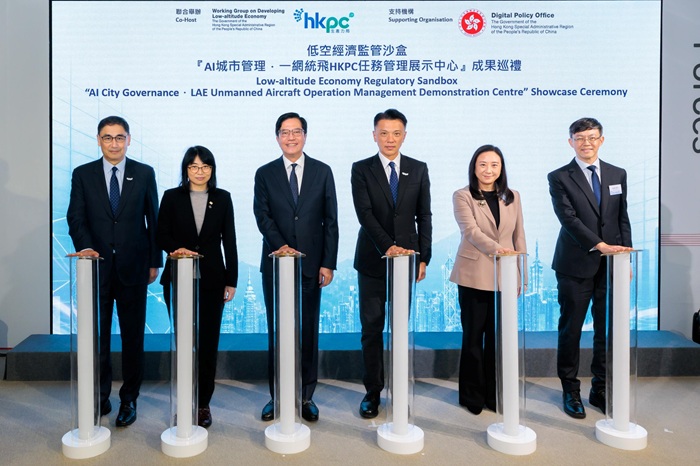 Low-altitude Economy Regulatory Sandbox X “AI City Governance • LAE Unmanned Aircraft Operation Management Demonstration Centre” Showcase Ceremony was officiated by Mr Wong Wai-lun, Michael, GBS, JP, Deputy Financial Secretary of the HKSAR Government (third left), Dr NG Ping Chung, Deputy Commissioner (Data Governance) (far right), Ms Clara WONG, JP, Director-General of Civil Aviation (second left), Hon Sunny TAN, BBS, Chaiman of HKPC (third right), Hon Elizabeth QUAT, SBS, JP, Greater Bay Area Low Altitude Economy Alliance Founding President (second right), and Mr Mohamed BUTT, MH, Executive Director of HKPC (far left).
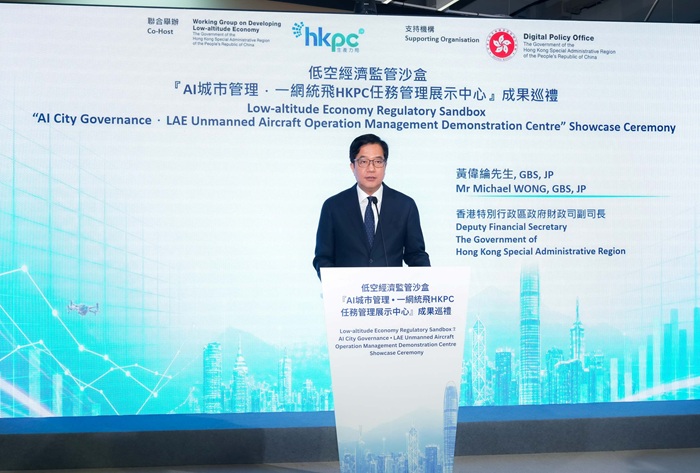 Mr WONG Wai-lun, Michael, GBS, JP, Deputy Financial Secretary of the HKSAR Government, said: "More than 20 government departments are participating in the "One-Network Unified Flight" shared platform. We believe the platform will deliver significant benefits in areas such as resource utilisation, flight route network coordination and AI-powered data analytics. This is only the beginning. Going forward, taking into account the needs and development plans of different departments, we will progressively incorporate more low-altitude public services into the platform as appropriate."
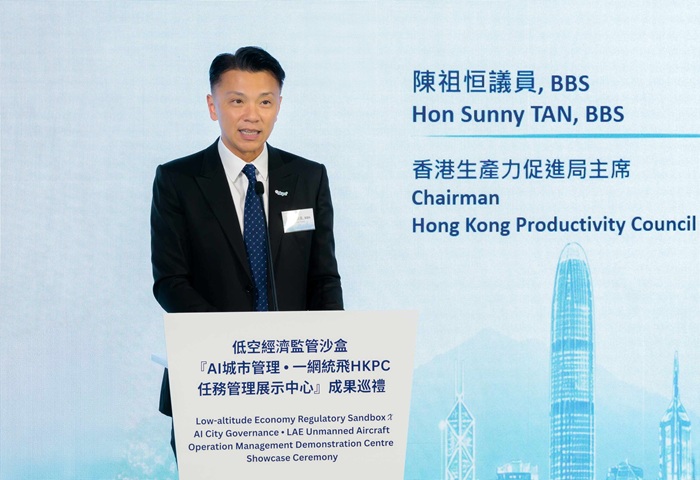 Hon Sunny TAN, BBS, Chairman of HKPC, said: "The UOM Centre is more than a technology exhibition platform. It represents an important step in advancing drone applications from a single pilot towards shared, platform-based and large-scale development. HKPC will continue to serve as a technical partner in the development of the low-altitude economy, connecting the upstream, midstream, and downstream of the industrial chain, and fostering collaboration among technology suppliers, application organisations, and various stakeholders."
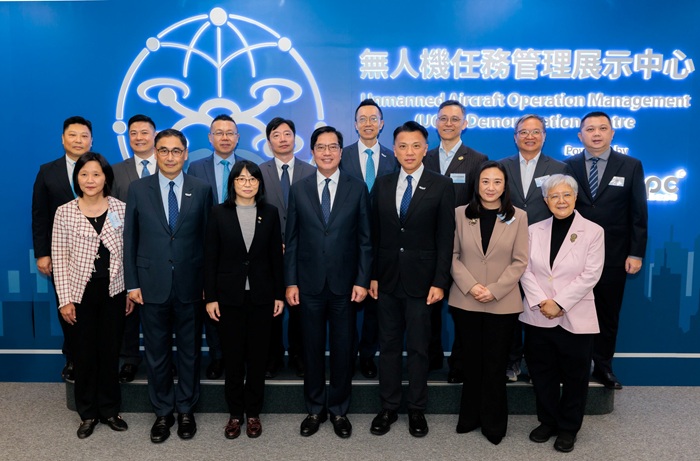 Mr WONG Wai-lun, Michael, GBS, JP, Deputy Financial Secretary of the HKSAR Government, and his delegation visited the UOM Centre to learn about the phased achievements of the Regulatory Sandbox's Multi-scenario / Multi-user Shared Platform.
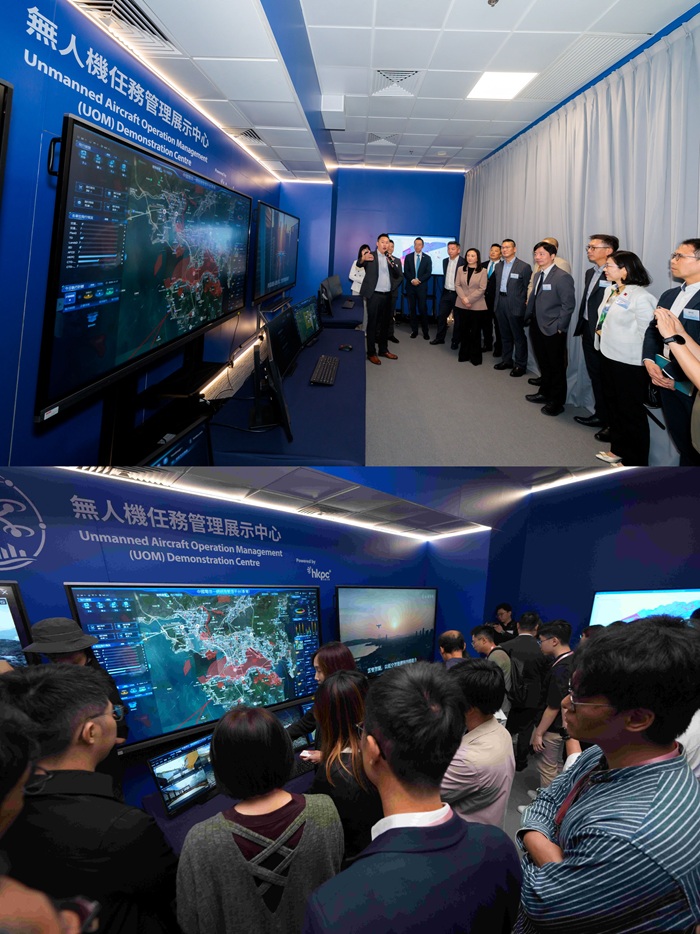 The UOM Centre, based on the concept of "AI-powered Urban Management • Unified Flight Operations", showcases the operational results and applications of three shared-platform projects and integrates drones, AI, data analytics and digital management technologies.
FOLLOW US
SUBSCRIBE TO OUR NEWSLETTERS
Share the latest information of HKPC to your inbox