
-
Our Services
- AI with HKPC PICASSO
- The Cradle – Go Global Service Centre
- New Industrialisation
-
Smart Manufacturing
- Smart Manufacturing
- IIOT
-
AI & Robotics
- AI & Robotics
- Unmanned Logistics Center Technology
- Applying Embodied Intelligence to Industrial Operations
- AI Sheet Metal Surface Defect Detection Technology
- Product Innovation and Design Management
- Smart Manufacturing/ New Industrialisation Assessment and Implementation
- Application and Research on Vision and Ultrasonic Inspection Assisted by Artificial Intelligence and Robotics
- Development and Implementation of Intelligent Production Lines
- Autonomous Air-ground Cooperative Tunnel Inspector
- AR-Empowered Robot Control System (ARERC System)
- IoT-enabled Smart Toilet Bowl Cleaning System
- Novel Materials
-
Advanced Manufacturing Technology
- Advanced Manufacturing Technology
- 3D Scanning and Reverse Engineering Service
- Flexible Metallic Fiber Physical Porous Part Fabrication Technology
- Dual Laser Metal Polishing Technology
- Advanced Additive Manufacturing, 3D Printing Technology, and Direct Manufacturing
- Electrically-Assisted Free Forming (EAFF) Technology for Customisation of Sheet Metal Parts
- Plastic Process and Machinery Technology
- Fashion and Garment Technology
- Watch Assembly Automation Technology
-
HealthTech and Traditional Chinese Medicine
- HealthTech and Traditional Chinese Medicine
- R&D service and Functional Investigation on Chinese Medicine, Health Food & Wellness product
- Compliance Consultation Service for Chinese Medicine, Pharmaceutical, Health Food and Medical Device Industries
- Manufacturing Enhancement - Automatic Intelligent System for Production and Packaging in Chinese Medicine, Pharmaceutical and Health Food Industries
- Assisting funding application for local medicine and health industrial associations
- “The Cradle” Services for Health Tech and TCM Industry
-
Digital Transformation
- Digital Transformation
- HKPC Digital DIY Portal
- Digital Transformation Support
- Intelligent Integrated Non-wearable and Wearable Health Monitoring System and App for Elderly Homes
- Smart Solution
- Research and Analytics
- Embedded Software System
- DevOps Maturity Assessment and Consultancy Service
- Software Testing Automation Consultancy Service
- Blockchain Consulting Service
- Extended Reality (XR) technology and consultancy service
-
Cyber Security
- Cyber Security
- Cyber Security
- Cybers Security-by-design, Privacy and Compliance-by-default
- Design & Architecture
- Train & Develop
- Offensive Security
- Intelligent Security
- Defensive Security
- Intelligent Hardening
- Internet of Things (IoT) & Operational Technology (OT) Cyber Security Testing
- Phishing Defence Services
- Cyber Security Assessment & Audit
- Cyber Security Consultancy for i4.0 & e4.0
-
Green & Smart Living
- Green & Smart Living
- Green Technology
- Food Technology
- Smart Living
-
Corporate Sustainability
- Corporate Sustainability
- ESG and Sustainability Services
- Manufacturing Technology (Tooling, Metals & Plastics) Recognition of Prior Learning (RPL) Mechanism
- Market Research and Analytics
- Business Innovation
- Sustainability-related Standards and Guidance
- Organisation Innovation Capability Development
- District Innovation
- Customer Service Assessment
- Intellectual Property (IP) Protection and Management
- Support to Creative Industries
- Manufacturing Standards Consultancy Service
- Production Capacity Optimisation
- Cost of Quality
- HKPC Academy
- SME Support
- Funding
- Testing & Standards
- Venues & Facilities
-
Support & Resource
- Technology Transfer
-
Support Centres
- Support Centres
- Embodied AI International Applications Hub
- Hong Kong Industrial Technology Centre for Marine Economy
- Deep Tech Innovation Hub
- Circularity Research Centre
- Future Life and Health Tech Centre & Future FoodTech Lab
- Hong Kong Industrial Artificial Intelligence Robotics Centre (FLAIR)
- Intellectual Property Services Centre
- The Cradle – Go Global Service Centre
- Agentic AI and Industrial Metaverse Hall
- HKPC-HP 3D Printing Technology Centre
- Future Manufacturing Hall
- Hong Kong Technology and Innovation Support Centre
- Inno Space
- The HATCH
- Advanced Electronics Processing Technology Centre
- Green Living Laboratory
- Reliability Testing Centre
- Electromagnetic Compatibility Centre
- Plastics Technology Centre
- Smart Wearables, Watch & Clock Technology Centre
- Hong Kong Digital Testing Hub
- Hong Kong Industrial Drone Technology Centre
- Aqua Research Laboratory
- Advanced Materials and Intelligent Manufacturing Centre
- Hong Kong Joint Research Lab for Applications of Intelligent Automation Technology
- Testing & Standards
- HKPC Spotlights
- About US
-
 LANGUAGE
HKPC Releases “Standard Chartered Hong Kong SME Leading Business Index” Q3 2026 Business Confidence Stabilises as Overall Index Rises to 44.1 One in Four SMEs Expands Cross-border Operations Market and Customer Development Emerges as Top Investment Priority
(Hong Kong, 9 July 2026) The Hong Kong Productivity Council (HKPC) today announced the “Standard Chartered Hong Kong SME Leading Business Index” (“Standard Chartered SME Index”) for the third quarter (Q3) of 2026. The survey results showed that the Overall Index recorded 44.1 this quarter, edging up by 0.8 from the previous quarter. The results reflected a slight improvement in overall business confidence among SMEs amid a more favourable external environment, although sentiment remained cautious.
“Standard Chartered SME Index” Survey Results
Among the five component sub-indices1, “Global Economy” sub-index recorded a significant rebound, rising by 12.2 to 33.1, and returning to the level in Q4 2025. This suggested that SMEs had become more optimistic about the external economic outlook. The largest increases were observed in the “Import / Export Trade and Wholesale” and “Professional and Business Services” industries, which rose by 15.6 and 15.3 respectively. The “Social and Personal Services”, “Manufacturing”, and “Financing and Insurance” industries also recorded increases of more than 10 points.
The other four sub-indices remained broadly stable. “Recruitment Sentiment” (50.5) and “Investment Sentiment” (50.0) continued to stay at or above the 50 neutral line. Meanwhile, “Business Condition” (40.5) and “Profit Margin” (37.8) remained below 50, indicating that SMEs were still cautious about short-term business performance and profitability prospects.
Regarding the cost components, the proportion of SMEs expecting raw material costs to increase declined by 3 percentage points to 64%, while still remaining at a relatively high level. At the same time, the proportion of SMEs anticipating staff salary increases continued to fall, dropping by 3 percentage points to 17%. Meanwhile, only 19% of SMEs planned to raise the prices of their products or services, a decline of 4 percentage points from the previous quarter.
The survey also examined the performance and challenges faced by SMEs that have already established sales operations in other Greater Bay Area (GBA) cities. Results showed that their overall revenue in other GBA cities remained stable over the past year. However, nearly 40% (39%) reported higher operating costs, mainly driven by increases in raw material and procurement expenses. Intense market competition, differences in customer demand between the two markets, as well as cross-border logistics and compliance requirements continued to pose challenges to SMEs expanding and operating in the GBA.
Mr Tommy WU, Senior Economist, Greater China and North Asia, Standard Chartered, said, “The improvement in our ‘Standard Chartered SME Index’ for Q3 was largely due to the easing in concerns over geopolitics following the US-Iran ceasefire since April and the decline in global oil prices towards pre-conflict levels. Strong exports amid the AI supercycle probably have a role to play, too. The recovery in retail industry and domestic demand more generally also likely help underpin SMEs hiring sentiment. However, the rise in CPI inflation on the lasting effects of the earlier surge in energy costs due to the Middle East conflict may weigh on consumer spending in H2. Also, the rise in energy costs is likely to be partly absorbed by companies, affecting SMEs profit outlook.”
Thematic Survey Results: SMEs’ Cross-border Business Expansion Trends
The thematic survey of this quarter explored the current situation and strategic plans of Hong Kong SMEs in operating cross-border business. The survey revealed that one-quarter (25%) of surveyed SMEs are already engaged in cross-border business, while another 11% indicated plans to expand into this area. However, 64% of SMEs currently have no plans to expand across borders. The main reasons included lack of manpower, high costs or insufficient capital, unfamiliarity with overseas markets, and perceived high risks, highlighting the key challenges SMEs face when going global.
Among SMEs that have already established cross-border business, 22% reported business expansion over the past year, while 14% experienced a contraction. Looking ahead, 32% plan to further expand their cross-border business in the coming year, reflecting proactive efforts to capture opportunities in overseas markets and broaden their customer base across different regions. To support these ambitions, SMEs identified market and customer development capabilities as their top priority, alongside strengthening digitalisation and financing, risk management, talent and team capabilities, and partnership networks to build a stronger foundation for going global.
Ms Karen FUNG, Chief Marketing Officer of HKPC, said, “Many SMEs face challenges in market selection, brand building and operational management when expanding across borders. In recent years, demand for relevant information, practical experience and networking platforms has continued to grow. HKPC has been supporting businesses by organising industry exchange activities and sharing market trends, helping enterprises better understand the latest developments in cross-border expansion. We also provide insights on brand development, digital operations and overseas market expansion, enabling businesses to formulate development strategies that suit their own needs.”
The survey also showed that many SMEs that are already operating cross-border businesses or planning to do so are considering introducing AI and digital technologies across different business functions. Applications included handling daily documentation, responding to customer enquiries or orders, understanding overseas markets and regulatory requirements, promoting and attracting overseas customers, and conducting market and sales analysis, with the objective of enhancing overall competitiveness when going global.
However, SMEs still require extensive support in leveraging AI to support their go-global initiatives. The most pressing need was AI training for employees (43%), followed by cybersecurity support (38%), technical support for implementing AI tools (37%), and guidance on selecting suitable AI solutions or vendors (29%). These findings reflected strong demand for end-to-end support, ranging from talent development to practical implementation.
Karen added that as AI technologies become increasingly integrated into business operations, enhancing AI application capabilities has become a key concern for many SMEs. Talent training and skills upgrading are also critical foundations for digital transformation. In line with the HKSAR Government’s direction to promote wider AI adoption, the HKPC Academy will continue to provide training and exchange opportunities at different levels, helping enterprises and practitioners understand the practical application of AI in workplace scenarios and acquire essential digital transformation knowledge, preparing businesses for sustainable growth and expansion into new markets.
Conducted in May and June 2026, the Standard Chartered SME Index Q3 2026 survey successfully interviewed 826 local SMEs, with an additional 20 local SMEs that have expanded into other GBA cities as booster samples for further analysis. The report will be available for download from HKPC website: https://www.hkpc.org/en/about-us/hkpc-publication/industry-insight/scbi.
1The five sub-indices include “Recruitment Sentiment”, “Investment Sentiment”, “Business Condition”, “Profit Margin” and “Global Economy”.
- Ends -
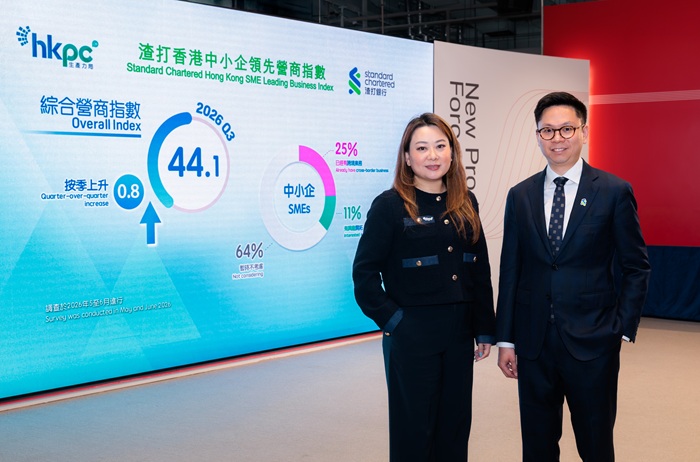 At the press conference of the Standard Chartered Hong Kong SME Leading Business Index Q3 2026, Ms Karen FUNG, Chief Marketing Officer of HKPC (left) and Mr Tommy WU, Senior Economist, Greater China and North Asia, Standard Chartered (right) announced that the Overall Index edged up by 0.8 to 44.1 this quarter.
FOLLOW US
SUBSCRIBE TO OUR NEWSLETTERS
Share the latest information of HKPC to your inbox