
-
Our Services
- AI with HKPC PICASSO
- The Cradle – Go Global Service Centre
- New Industrialisation
-
Smart Manufacturing
- Smart Manufacturing
- IIOT
-
AI & Robotics
- AI & Robotics
- Unmanned Logistics Center Technology
- Applying Embodied Intelligence to Industrial Operations
- AI Sheet Metal Surface Defect Detection Technology
- Product Innovation and Design Management
- Smart Manufacturing/ New Industrialisation Assessment and Implementation
- Application and Research on Vision and Ultrasonic Inspection Assisted by Artificial Intelligence and Robotics
- Development and Implementation of Intelligent Production Lines
- Autonomous Air-ground Cooperative Tunnel Inspector
- AR-Empowered Robot Control System (ARERC System)
- IoT-enabled Smart Toilet Bowl Cleaning System
- Novel Materials
-
Advanced Manufacturing Technology
- Advanced Manufacturing Technology
- 3D Scanning and Reverse Engineering Service
- Flexible Metallic Fiber Physical Porous Part Fabrication Technology
- Dual Laser Metal Polishing Technology
- Advanced Additive Manufacturing, 3D Printing Technology, and Direct Manufacturing
- Electrically-Assisted Free Forming (EAFF) Technology for Customisation of Sheet Metal Parts
- Plastic Process and Machinery Technology
- Fashion and Garment Technology
- Watch Assembly Automation Technology
-
HealthTech and Traditional Chinese Medicine
- HealthTech and Traditional Chinese Medicine
- R&D service and Functional Investigation on Chinese Medicine, Health Food & Wellness product
- Compliance Consultation Service for Chinese Medicine, Pharmaceutical, Health Food and Medical Device Industries
- Manufacturing Enhancement - Automatic Intelligent System for Production and Packaging in Chinese Medicine, Pharmaceutical and Health Food Industries
- Assisting funding application for local medicine and health industrial associations
- “The Cradle” Services for Health Tech and TCM Industry
-
Digital Transformation
- Digital Transformation
- HKPC Digital DIY Portal
- Digital Transformation Support
- Intelligent Integrated Non-wearable and Wearable Health Monitoring System and App for Elderly Homes
- Smart Solution
- Research and Analytics
- Embedded Software System
- DevOps Maturity Assessment and Consultancy Service
- Software Testing Automation Consultancy Service
- Blockchain Consulting Service
- Extended Reality (XR) technology and consultancy service
-
Cyber Security
- Cyber Security
- Cyber Security
- Cybers Security-by-design, Privacy and Compliance-by-default
- Design & Architecture
- Train & Develop
- Offensive Security
- Intelligent Security
- Defensive Security
- Intelligent Hardening
- Internet of Things (IoT) & Operational Technology (OT) Cyber Security Testing
- Phishing Defence Services
- Cyber Security Assessment & Audit
- Cyber Security Consultancy for i4.0 & e4.0
-
Green & Smart Living
- Green & Smart Living
- Green Technology
- Food Technology
- Smart Living
-
Corporate Sustainability
- Corporate Sustainability
- ESG and Sustainability Services
- Manufacturing Technology (Tooling, Metals & Plastics) Recognition of Prior Learning (RPL) Mechanism
- Market Research and Analytics
- Business Innovation
- Sustainability-related Standards and Guidance
- Organisation Innovation Capability Development
- District Innovation
- Customer Service Assessment
- Intellectual Property (IP) Protection and Management
- Support to Creative Industries
- Manufacturing Standards Consultancy Service
- Production Capacity Optimisation
- Cost of Quality
- HKPC Academy
- SME Support
- Funding
- Testing & Standards
- Venues & Facilities
-
Support & Resource
- Technology Transfer
-
Support Centres
- Support Centres
- Embodied AI International Applications Hub
- Hong Kong Industrial Technology Centre for Marine Economy
- Deep Tech Innovation Hub
- Circularity Research Centre
- Future Life and Health Tech Centre & Future FoodTech Lab
- Hong Kong Industrial Artificial Intelligence Robotics Centre (FLAIR)
- Intellectual Property Services Centre
- The Cradle – Go Global Service Centre
- Agentic AI and Industrial Metaverse Hall
- HKPC-HP 3D Printing Technology Centre
- Future Manufacturing Hall
- Hong Kong Technology and Innovation Support Centre
- Inno Space
- The HATCH
- Advanced Electronics Processing Technology Centre
- Green Living Laboratory
- Reliability Testing Centre
- Electromagnetic Compatibility Centre
- Plastics Technology Centre
- Smart Wearables, Watch & Clock Technology Centre
- Hong Kong Digital Testing Hub
- Hong Kong Industrial Drone Technology Centre
- Aqua Research Laboratory
- Advanced Materials and Intelligent Manufacturing Centre
- Hong Kong Joint Research Lab for Applications of Intelligent Automation Technology
- Testing & Standards
- HKPC Spotlights
- About US
-
 LANGUAGE
HKPC Releases “Standard Chartered Hong Kong SME Leading Business Index” Q1 2026 Overall Index Stayed 43.9, Signaling Steady Market Development 75% SMEs Expanded AI Applications Compared To 2024, Seizing AI New Opportunities
(Hong Kong, 15 January 2026) The Hong Kong Productivity Council (HKPC) today announced the “Standard Chartered Hong Kong SME Leading Business Index” (“Standard Chartered SME Index”) for the first quarter (Q1) of 2026. The survey results indicated that the Overall Index recorded 43.9 for this quarter, maintaining overall stability, indicating steady market development and that SMEs remain cautiously optimistic outlook on the business environment.
“Standard Chartered SME Index” Survey Results
Among the five component sub-indices1, “Global Economy” sub-index maintained its upward trajectory (36.4, +3.8), returning to the level in Q4 2024. The “Transportation, Storage and Courier Services” and “Social and Personal Services” recorded the largest increases in the “Global Economy” sub-index, rising by 13.7 and 13.3 respectively. Meanwhile, “Recruitment Sentiment” (50.6, -0.1) and “Investment Sentiment” (49.7, -0.7) remained close to the 50 neutral line, showing stable performance. However, “Business Condition” (39.5, -1.1) and “Profit Margin” (36.6, -2.4) saw slight declines this quarter.
Regarding the changes in cost components, 46% of SMEs expected an increase in raw material costs this quarter, similar to the last quarter, while 21% anticipated an increase in staff salaries, with a 5-percentage-point increase from the previous quarter. Under this cost pressure, 18% of SMEs planned to increase the prices of their products or services, representing a 2-percentage-point rise compared to the last quarter.
In terms of overall investment trends, 95% of surveyed SMEs intended to maintain or increase their investment this quarter, with 6% specifically stating that they would increase their investment, consistent with the last quarter. The areas that most SMEs expected to increase investment included “Facilities and Equipment”, “IT System”, “Marketing Promotion” and “Office/ Factory/ Store”.
Mr Hunter CHAN, Economist, Greater China, Standard Chartered, said, “The ‘Standard Chartered SME Index’ moderated to 43.9 in Q1 2026 yet it was still higher than the average 2025 reading of 42.9. While the ‘Global Economy’ sub-index continued to improve (+3.8) partly thanks to the US-China trade truce in late October 2025, our surveyed SMEs appear to have turned more cautious on the ‘Business Condition’ and ‘Profit Margin’ aspects of the index. Although SMEs expect staff salary and raw material costs to increase further in Q1 2026, their hiring and investment incentive remained relatively stable, indicating a steady long-term outlook.”
Mr CHAN continued, “Sentiment was mixed across industries. Industry Index for ‘Information and Communications’ increased significantly – the only industry to register an above-50 reading, likely benefiting from the global AI boom. Readings for the ‘Accommodation and Food Services’, ‘Real Estate’ and ‘Social and Personal Services’ industries continued to pick up after their Q4 recovery. Meanwhile, ‘Construction’ SMEs turned more gloomy on the outlook. Improved expectations of the global outlook likely helped cushion sentiment among SMEs in the ‘Manufacturing’, ‘Import / Export Trade and Wholesale’ and ‘Transportation, Storage and Courier Services’ industries.”
Thematic Survey Results: AI Adoption Trends Among SMEs
The thematic survey of this quarter explored the status and trends of AI adoption among Hong Kong SMEs. The survey revealed that over half (55%) of surveyed SMEs have used or plan to use AI tools in their daily operation within the next year. “Information and Communications” (92%) demonstrated the highest adoption rate, followed by “Professional and Business Services” (72%), “Financing and Insurance” (62%) and “Manufacturing” (60%).
Among SMEs that have used AI, over 30% (32%) reported using paid AI tools, with the highest usage in “Information and Communications” (64%), “Financing and Insurance” (47%) and “Manufacturing” (31%). The most popular AI tools among SMEs were “Chatbots” and “Text / Document Generators / Optical Character Recognition (OCR) tools”, followed by “Voice Generators / Speech-to-text”, “Image / Video Generators” and “Data Analysis and Prediction Tools”. Among them, nearly 60% (59%) indicated that they were using more than one type of AI tools.
The survey also found that three-quarters (75%) of SMEs that have used AI expanded their AI applications in 2025 compared to 2024, including diversifying the types of AI tools employed (64%), increasing the number of employees using AI (56%), and broadening AI applications to more business areas (48%). When asked about the ease of using AI in 2025 compared to 2024, nearly half (47%) of SMEs that have used AI found it easier, primarily due to the maturity of AI technologies, the wider selection of AI tools available on the market, and increased employee acceptance.
Looking ahead to the coming year, most SMEs that have used AI expect further integration by broadening the variety of AI tools employed (52%), extending AI applications to more business areas (41%) and increasing the number of employees using AI (40%). Additionally, 27% intend to increase investment in AI.
Mr Edmond LAI, Chief Digital Officer of HKPC, said, “The thematic survey results show that more SMEs are actively integrating AI into their business operations and planning to invest resources to expand AI applications. Nearly 60% (59%) of surveyed SMEs that have used AI employ more than one type of AI tools, clearly indicating that AI is becoming a cornerstone for enhancing competitiveness and driving demand for integrated AI solutions. While businesses acknowledge the importance of AI and have started applying it, most are still using AI for highly repetitive or administrative tasks. There remains a significant gap in fully unleashing AI’s potential. As a steadfast supporter of SMEs, HKPC continues to play four key roles—promoter, connector, implementer, and gatekeeper—to provide SMEs with comprehensive support for AI-driven transformations. Among its initiatives, HKPC developed the ‘HKPC Picasso’ multipurpose AI platform, which integrates a wide range of common development tasks—such as data annotation and model deployment—along with validated, standardised core AI modules, featuring extensible architecture and component library. The platform delivers tailored, integrated solutions to meet the needs of different industries, significantly reducing users’ time for developing AI applications, helping SMEs better seize the AI opportunities.”
Mr Lai highlighted that some retail companies have already deployed AI systems to analyse sales data and predict demand through deep learning, which optimise production schedules, inventory, and distribution processes, significantly enhancing operational efficiency and market responsiveness. In response to industry demand for AI applications, HKPC will host the “AI with HKPC” Smart Solutions Showcase Series in early February to support SMEs grasp the latest trends across sectors, foster exchanges, and promote innovative development.
Conducted between November and December 2025, the Standard Chartered SME Index Q1 2026 survey successfully interviewed 819 local SMEs. The report will be available for download from HKPC website: https://www.hkpc.org/en/about-us/hkpc-publication/industry-insight/scbi
1The five sub-indices include “Recruitment Sentiment”, “Investment Sentiment”, “Business Condition”, “Profit Margin” and “Global Economy”.
- Ends -
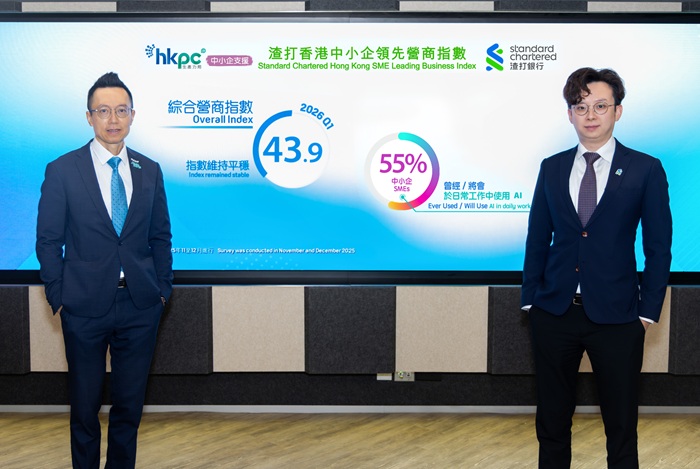 At the press conference of the Standard Chartered Hong Kong SME Leading Business Index Q1 2026, Mr Edmond LAI, Chief Digital Officer of HKPC (left) and Mr Hunter CHAN, Economist, Greater China, Standard Chartered (right) announced that the Overall Index stayed at 43.9, which has remained stable.
FOLLOW US
SUBSCRIBE TO OUR NEWSLETTERS
Share the latest information of HKPC to your inbox